Sleeping Bag Fill Weight Explained: Real Warmth Calculation
By Anik Bose • 26th Jun
As the title suggests, this is sleeping bag fill weight explained in practical terms: how much insulation is in your bag, how that relates to loft, and how to do a rough fill weight warmth calculation that actually predicts your night rather than just filling a spec sheet.
Most people shopping for the warmest sleeping bag get stuck between numbers: fill weight, fill power, and ISO/EN temperature ratings. This FAQ deep dive is designed for spreadsheet users and cold-sleepers who want a transparent, quantitative way to choose their bag (and to know when they can safely push it or need to level up).
Definitions up front
What is "fill weight" in a sleeping bag?
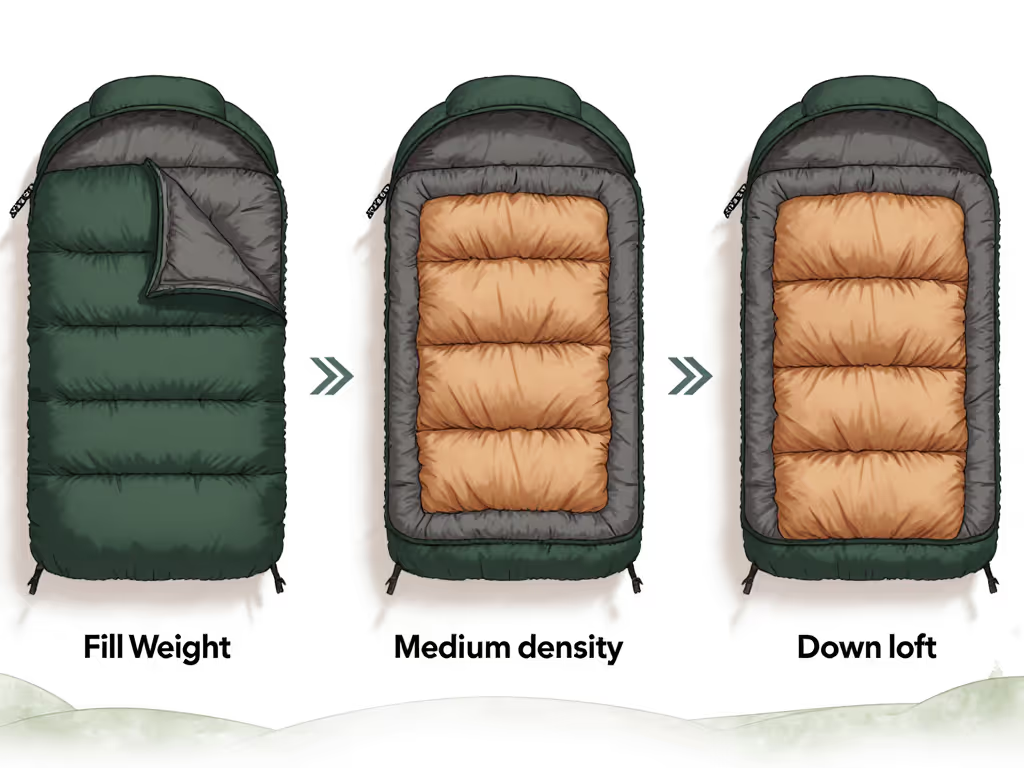
Fill weight is the mass of insulation inside the bag, usually listed in grams or ounces.
- For down bags, it is the total weight of down feathers used.
- For synthetic bags, it is the weight of the synthetic insulation.
More fill weight generally means more potential warmth, but only when you compare bags with the same type of insulation and similar construction.
Plain-language footnote: Fill weight tells you how much insulation you're carrying, not automatically how warm you'll be.
What is "fill power," and how is it different?
Fill power measures the quality and fluffiness of down: how many cubic inches one ounce of down can loft to under standard test conditions (e.g., 600, 800, 900+).
- Higher fill power = down traps more air per gram and can reach higher loft.
- That gives better warmth-to-weight ratio calculation: you can reach the same warmth with less total down weight.
In short:
- Fill power = quality and efficiency.
- Fill weight = quantity and capacity.
You need both numbers to say anything meaningful about warmth.
Which matters more: fill weight vs fill power explained simply?
Within the same down quality and bag design, fill weight is the primary driver of warmth.
Between different down qualities, fill power determines how much warmth you get per gram.
A helpful way to think about it:
- If two bags both have 500 g of down, the one with higher fill power (say 850 vs 650) will be warmer and more compressible.
- If two bags both use 800-fill down, the one with more fill weight will be warmer, but also heavier and bulkier.
For most field decisions:
- Choose fill power to match your goals (ultralight vs budget).
- Use fill weight (plus ISO rating) to estimate actual warmth. For a step-by-step formula to compare bags, use our fill weight vs fill power guide.
From lab numbers to real nights
How does the down fill weight temperature relationship work?
Manufacturers combine fill power, fill weight, baffle design, and shell fabric to hit a target ISO/EN temperature rating. Fill weight is the main "knob" they turn to add or remove warmth for a given design.
Practical patterns you'll see in many modern down bags (ballpark ranges, not rules):
- Around 300 g of down: often aimed at mild conditions, roughly 5-10 °C / 40-50 °F.
- Around 500 g: common for 0 to -5 °C / 32-23 °F "3-season" style ratings.
- Around 700 g+: typically for serious sub-zero / expedition-type ratings.
Those ranges assume decent fill power (600+), efficient mummy cuts, and proper baffling. A wide, poorly baffled bag may need more fill weight to hit the same rating.
Lab-to-field translation: Think of fill weight as potential warmth volume. The ISO rating tells you how that potential performed on a thermal manikin in still, dry air. Your job is to adjust for pad, shelter, wind, humidity, and your metabolism.
Can I do a simple fill weight warmth calculation at home?
You cannot convert fill weight to an exact temperature on your own, but you can use it as a sanity check and to compare bags within a category.
Here's a practical, rules-of-thumb approach for down bags:
- Stay within one category when comparing: all down, similar fill power (±50), similar cut (mummy vs roomy), and full-length bags.
- For 650-800-fill down in an efficient mummy:
- Each +100 g of down often equates to ~4-6 °C (7-10 °F) of additional warmth potential, within the same model family.
- Cross-check against the published EN/ISO comfort and lower-limit ratings; treat your calculation as a check, not a replacement.
Uncertainty range: expect at least ±5 °C (±9 °F) between lab ratings, your calculation, and your actual comfort, because of pad R-value, wind, humidity, and your personal metabolism.
Method first, model second, field test: use fill weight and fill power to build a model, but always calibrate against your own nights and ISO ratings.
Why can two bags with similar fill weight feel different in warmth?
Because fill weight is only one variable. Major factors:
- Cut and fit: A narrow mummy with the same fill weight will feel warmer than a big rectangular bag because there's less air to heat and fewer gaps.
- Baffle design: Differential cuts, continuous vs boxed baffles, and draft tube quality change how evenly loft is distributed and how well it stays put overnight.
- Shell fabrics: Wind-resistant outers can reduce convective heat loss; more breathable but air-permeable fabrics may feel cooler in windy conditions.
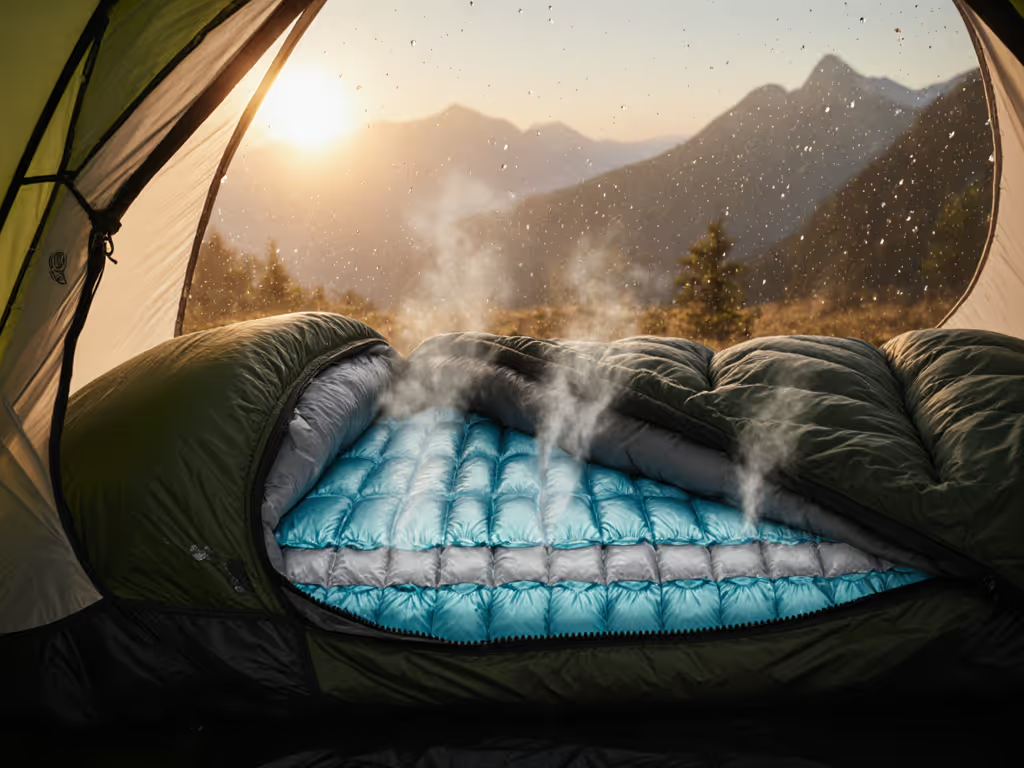
- Moisture management: Damp down loses loft and warmth, particularly in humid or coastal environments.
That's why a "thicker" budget bag with heavy but low-fill-power down can feel colder than a lighter, high-quality bag with well-designed baffles.
How do ISO/EN temperature ratings relate to fill weight?
ISO 23537 (and the older EN 13537) use a heated thermal manikin in a controlled climate chamber to determine comfort, lower-limit, and extreme temperatures. The bag's fill weight is just one design input; the rating is the outcome.
According to multiple guides, ISO/EN ratings are still the most reliable cross-brand comparison tool we have, but you should interpret them conservatively:
- Many cold-sleepers and a high share of women sleep closer to the comfort rating than the lower-limit.
- Shoulder-season and alpine users should treat the comfort rating as the realistic planning number, then add a safety margin of ~5 °C (9 °F). For a deeper translation of standards to field temps, see our EN/ISO ratings decoder.
"Standards inform; translation delivers real sleep in real weather." Watching a manikin cycle through protocols in still, dry air is exactly what showed me how much work is left for your pad, tent, and habits.
The rest of the system: pad, shelter, and you
How does pad R-value interact with fill weight?
Your pad controls conductive heat loss to the ground; your bag handles mostly convective and radiant loss to the air.
- A low-R pad (e.g., ~R 1-2) can make a generously filled bag feel a full one rating class colder.
- A higher-R pad (R 4-5) often gains you ~3-5 °C (5-9 °F) of perceived warmth before you ever change bags.
Many cold nights blamed on "not enough fill weight" are actually pad-limited systems.
How much do wind and shelter type change the effective rating?
Wind strips the warm air boundary layer around your bag, especially in single-wall tents, tarps, or hammocks.
Rough heuristics (assuming you can block direct drafts but not all wind):
- Single-wall or tarp, breezy: plan for your bag to feel ~3-5 °C (5-9 °F) colder than its rating.
- Double-wall tent, sheltered site: often close to the ISO rating, if your pad and clothing are dialed.
Here again, fill weight cannot compensate for a fully exposed, drafty setup; that's a shelter and site-selection problem first.
How should women and known cold-sleepers adjust?
Guides consistently recommend that colder sleepers:
- Aim for the comfort rating rather than lower-limit as their realistic "can sleep" temperature.
- Add 5 °C / 9 °F of safety margin for shoulder seasons or if using marginal pads.
- Consider slightly warmer bags or higher fill weights than a similarly sized warm sleeper. If you consistently sleep colder or warmer than partners, our picks for cold vs warm sleepers help you match bag designs to your metabolism.
From a practical standpoint, if your partner sleeps warm in a 20 °F bag at freezing, you might want a bag with:
- The same rating but more conservative pad and clothing, or
- A warmer rating (e.g., 10-15 °F) with higher fill weight.
What about synthetic insulation, does fill weight work the same way?
Synthetic insulations are not directly comparable to down by fill weight because:
- They typically have lower warmth-to-weight efficiency.
- They hold warmth better when damp and dry faster, but need more grams to reach the same rating as a given down bag.
Still, within the same synthetic line, more fill weight generally means more warmth. Again, cross-check with the ISO rating rather than relying on grams alone.
Practical heuristics and next steps
How can I quickly compare two candidate bags?
When you're staring at spec sheets, run this simple workflow:
- Lock in your coldest realistic night. Add ~5-10 °F (3-6 °C) as a buffer, especially for shoulder seasons or windy alpine camps.
- Filter by ISO/EN comfort rating near that buffer temperature; ignore marketing "comfort" claims without method.
- Within that filtered set, compare:
- Fill power: choose higher if weight/packability matter and your budget allows.
- Fill weight: note differences of ≥100 g, they are usually meaningful.
- Shape: ensure the cut fits your body and sleep style so you're not compressing insulation or creating dead air.
- Sanity-check against your pad R-value and shelter. If your pad is under R 3 for freezing conditions, prioritize upgrading it before jumping to a much heavier bag.
Any simple "field translation" rule I can write in my trip notebook?
Try building a personal line like this for each bag you own:
"For me, this bag's comfort rating + R X pad + [shelter type] = comfortable down to about Y °C / °F."
Then refine Y over a few trips:
- Note actual overnight low, wind, humidity, and what you wore.
- Mark whether you were chilled, neutral, or toasty.
- Adjust your personal comfort floor for that bag in 2-3 °C (3-5 °F) increments as you collect data.
That gives you your own down fill weight temperature relationship, tuned to your metabolism and system instead of an anonymous manikin.
Where to explore further
If you want to go deeper than "this bag is warm enough," the next steps are:
- Build a small sleep system spreadsheet with columns for bag fill power, fill weight, ISO comfort rating, pad R-value, shelter, clothing, and your personal comfort floor.
- Use manufacturer charts and independent tests to validate any surprising outliers in fill weight vs rating.
- Experiment with pad upgrades and layering before buying a completely new bag; many cold-sleep problems are solved more efficiently under you than over you.
Once you've logged a few trips this way, you'll have something more powerful than a generic calculator: a personal model that makes sense of fill weight, fill power, and ratings for your body. From there, you can confidently dial one primary setup and know exactly when you're stretching it (and by how much).
Related Articles