Fill Weight vs Fill Power: Calculate Bag Warmth
By Anik Bose • 15th Mar
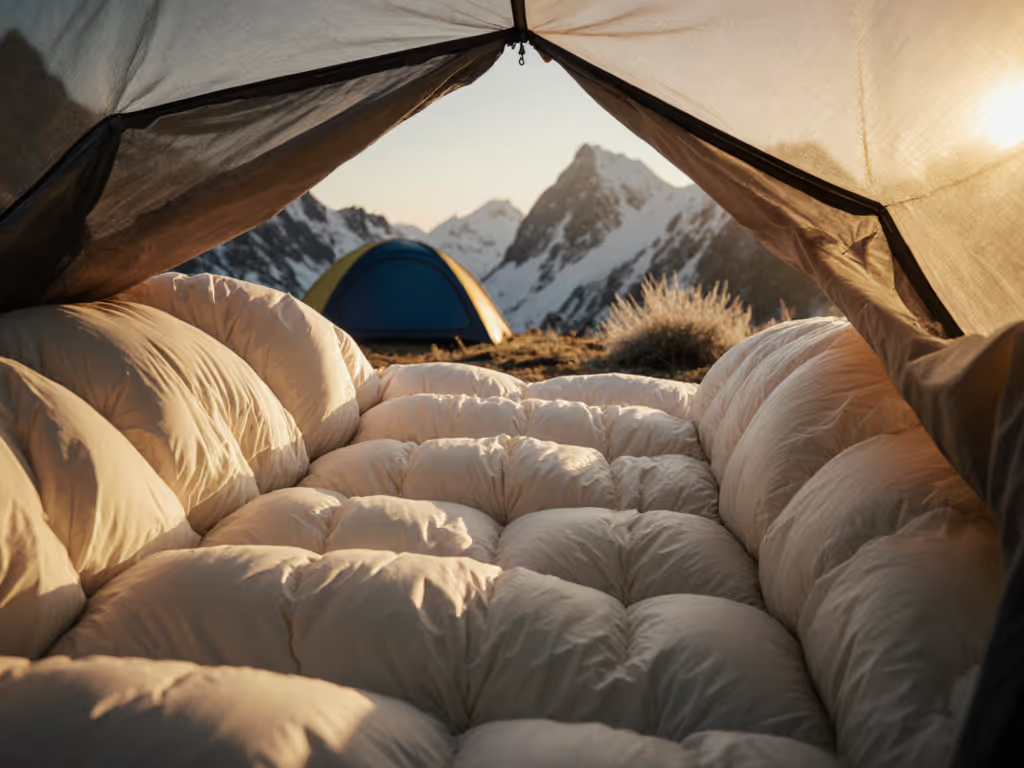
Sleeping bag fill weight explained and fill weight vs fill power are two distinct concepts that backpackers, campers, and adventure travelers confuse regularly (and with good reason). They sound similar, influence warmth in different ways, and are rarely taught together in practical terms. The confusion runs deeper than terminology: it reflects a gap between what lab standards claim and what you actually feel inside your bag on a cold night.
I learned this firsthand during a factory tour years ago. Standing beside a thermal manikin cycling through ISO protocols in still, controlled air, I watched technicians measure loft with precision. Yet that manikin had never felt wind, never encountered humidity from your sleeping clothes, never met a mat that slipped during the night. That day clarified the core challenge: standards inform; translation delivers real sleep in real weather. This article bridges that gap by defining both metrics, showing how they calculate bag warmth together, and providing heuristics you can use before your next trip.
What Is Fill Power, and Why Does It Matter?
Fill power is a lab-measured rating of down quality and loft efficiency, expressed as the volume (in cubic inches) that one ounce of down occupies under standardized compression. A higher number (say, 900-fill) means each feather cluster traps more air and expands more fully than lower-fill down like 600-fill. The test itself is consistent: down is placed in a cylinder, a calibrated weight (94.25 grams in European standards, slightly different in US tests) compresses it from above, and the resulting volume is recorded. For a deeper dive into measurement and real-world impact, see our fill power guide.
Why this matters in the field: higher fill power means the same warmth in less weight and smaller pack volume. For example, 50 grams of 900-fill-power down provides the same insulation as 100 grams of 450-fill-power down, but weighs half as much. That translates to a sleeping bag that might weigh 12 ounces less and compress to noticeably smaller dimensions (a meaningful margin when you're hiking 10 miles with a full pack).
However, fill power does not directly determine warmth. This is the first critical translation point. A 900-fill jacket feels cold if it contains only 30 grams of down. The same 900-fill with 120 grams feels considerably warmer. Fill power is potential; fill weight is the actualization.
What Is Fill Weight, and How Does It Affect Warmth?
Down fill weight is the total quantity of down used in a product, measured in grams or ounces. It is an exact, physical measurement: place the finished sleeping bag on a scale and subtract the shell weight, and you have the fill weight. Unlike fill power, which describes quality, fill weight describes quantity.
Fill weight directly correlates with warmth in a straightforward relationship: more down mass traps more heat. A sleeping bag with 200 grams of 800-fill down is warmer than one with 100 grams of 800-fill down, all else equal. But here lies the second key translation: more fill weight also means more packed weight and bulk, assuming the same fill power.
Manufacturers often vary fill weight within a single bag to optimize efficiency. For instance, the top of a mummy bag typically contains more down than the bottom, because your sleeping mat already insulates the underside. Some premium bags feature open baffles that let you redistribute down by shaking, giving you partial control over where insulation is concentrated.
How Fill Power and Fill Weight Work Together
Warmth is a function of both fill power and fill weight; neither tells the full story alone. Think of it as a two-axis system:
- Fill power determines efficiency: how well a given mass of down converts to loft and heat trapping, and how compressible it is.
- Fill weight determines capacity: the total amount of insulation you're carrying and deploying.
A practical example: Two bags are both rated 15°F comfort temperature. One uses 850-fill-power down with a moderate fill weight and weighs 1 pound 12 ounces. The other uses 650-fill-power down with more generous fill weight and weighs 2 pounds 8 ounces. Both meet the same ISO temperature standard, but the lighter bag is more compressible, while the heavier bag may provide a greater margin of safety if fill power varies batch-to-batch or if the design is more generously cut.
Ratings predict; systems deliver (the combination of fill power, fill weight, and how the down is distributed through baffles determines what you actually experience in the field).
Lab-to-Field Translation: What ISO Ratings Don't Tell You
Sleeping bags often carry ISO (International Organization for Standardization) or EN (European Norm) temperature ratings that come from controlled lab tests. Get a practical primer on temperature ratings explained before you rely on a number. These tests measure a bag's ability to retain warmth under standardized conditions: still air, a standardized mat (typically R-value ~4), a thermal manikin dressed in standardized clothing, and zero wind or humidity fluctuation.
Your actual sleep experience depends on factors outside that test:
Shelter type and wind: Lab tests assume still air. Real tents and bivy sacks vary in protection. Wind can degrade a 20°F bag's effective warmth by 10-15°F or more if drafts bypass your insulation. Double-wall tents protect better than single-wall; open-air bivy sites offer no shelter at all.
Pad R-value: The lab uses a reference mat; you use yours. If your mat has R-value 2.0 and the test assumed R 4.0, conductive heat loss through the underside increases (effectively dropping your bag's performance by 10-20°F or more depending on the delta). Pad synergy is often the biggest field-to-lab gap.
Moisture and humidity: Down insulation fails when wet. Humid coastal conditions, condensation on the inside of your tent, or sweat-soaked sleepwear can degrade down performance before you notice. Synthetic insulation resists this better, though it is heavier for the same warmth rating. See the tradeoffs in our down vs synthetic comparison when conditions turn damp.
Baffle construction and draft leakage: A bag with poorly sealed baffles or a drafty footbox loses warmth faster than the test predicts. Understand construction choices in our sleeping bag baffles guide. Bag shape also matters: a roomy rectangular bag requires more insulation to warm up than a snug mummy, because dead space around your body doesn't trap your metabolic heat as efficiently.
Your body and metabolism: Lab manikins have fixed thermal output. Humans vary. Cold sleepers, light sleepers, and side sleepers who compress insulation against their body can drop effective warmth by 10-15°F versus the rating. Conversely, high-metabolism athletes may find the same bag warmer than stated.
Lab-to-Field Translation Box: Estimating Your Real Warmth
If an ISO-rated bag claims 20°F comfort, your real field experience might be:
- R-value pad ≥ 4.0, double-wall shelter, calm conditions, average metabolism → ~20°F (as rated)
- R-value pad 2.5-3.5, single-wall tent, wind exposure → ~10-15°F (5-10°F loss)
- R-value pad < 2.5, minimal shelter, high humidity, cold metabolism → 0°F or worse (20°F+ loss)
State your assumptions: pad R-value, expected wind, shelter type, your sleep metabolism, and how you sleep (position, whether you slip off the pad). Adjust downward for margin of safety in shoulder-season and alpine trips.
How to Calculate Sleeping Bag Warmth: A Practical Framework
To estimate warmth-to-weight ratio and warmth-to-cost ratio, follow this structure:
Step 1: Identify your target temperature range (not just the ISO comfort rating).
Step 2: Note fill weight and fill power. Calculate efficiency ratio as fill power ÷ fill weight (grams). Higher ratios mean more loft per gram. Example: 900 ÷ 80g = 11.25; 600 ÷ 80g = 7.5. The first is more efficient and compresses smaller.
Step 3: Cross-reference ISO ratings for bags in your target range. Bags with the same ISO rating but different fill-power and fill-weight combos will feel similar in the field (if construction is comparable).
Step 4: Estimate your real field temperature using the translation box above. Subtract 5-15°F from the ISO comfort rating depending on your pad R-value and shelter type.
Step 5: Choose for your margins. If you expect to camp at 25°F, don't rely on a 20°F bag; target 10°F or lower to build in margin for wind, moisture, and individual variation.
Fill Weight vs. Fill Power: When Does Each Matter More?
For ultralight backpacking and high-altitude mountaineering, fill power dominates the decision. Climbers and ultralight trekkers accept minimal fill weight but demand extreme efficiency to keep total pack weight low. An 850+ fill-power sleeping bag with carefully calibrated fill weight (say, 100-150g for a 0°F bag) is the standard. Every ounce counts, and compression is essential.
For weekend car camping and family setups, fill weight matters more. You have vehicle capacity and are less sensitive to pack volume. A bag with 700-fill and generous fill weight (250-350g) may cost less and feel just as warm as a premium 900-fill bag with minimal fill, and it leaves room for buying other quality gear (a good pad, a tent that doesn't leak).
For shoulder-season backpacking (the most common use case), both matter equally. You want enough efficiency (600-850 fill) to keep the bag packable and reasonably light, but enough fill weight (120-180g for a 20°F bag) to give you the warmth margin you need for cold nights and variable conditions.
Common Scenarios: What "Good" Bags Look Like
Alpine, extreme-weather expedition: 900-fill goose down, 20°F ISO rating, 48-56 ounces (1.4-1.6 kg fill weight ~40-50g). Example: high-end expedition bags. Rationale: extreme efficiency, every ounce minimized, willingness to pay premium for the efficiency.
Backpacker, 3-season trips: 700-850 fill, 20°F ISO rating, 24-32 ounces (680-900g fill weight ~120-160g). Rationale: balanced efficiency and cost, adequate compressibility, good warmth margin for variable conditions. For model picks that balance warmth and weight, browse our best backpacking sleeping bags.
Car camper, family use: 600-700 fill, 20°F ISO rating, 32-48 ounces (900g-1360g fill weight ~200-280g). Rationale: lower cost, robust, adequate packability for car-based trips, generous warmth for restless sleepers and varied positions.
Key Takeaways and Your Next Step
Fill power and fill weight are not interchangeable: fill power measures down quality and loft efficiency (cubic inches per ounce under lab compression); fill weight measures total insulation (grams or ounces in the product). Together, they predict a bag's warmth, but only under controlled lab conditions. Your real field experience depends on pad R-value, shelter type, wind, humidity, and your individual metabolism.
When choosing a sleeping bag, avoid over-indexing on fill power alone. A 900-fill bag with minimal down may not outperform a thoughtfully designed 700-fill bag with more generous fill weight, especially if your pad is modest or your shelter is exposed. Conversely, don't assume more fill weight always means better warmth if the down is low-loft and the bag is loosely cut.
Your action: Calculate your real field temperature using the lab-to-field translation framework above. State your pad R-value, expected shelter type, and target trip season. Cross-reference 2-3 bags in your ISO-rating target, compare fill power and fill weight, and pick the one that meets your warmth margin while balancing packability and budget. Test it on a cool night before a high-stakes trip. Ratings predict; systems deliver.
Related Articles