Your True Comfort Limit: Personalizing EN Ratings
By Anik Bose • 8th Apr
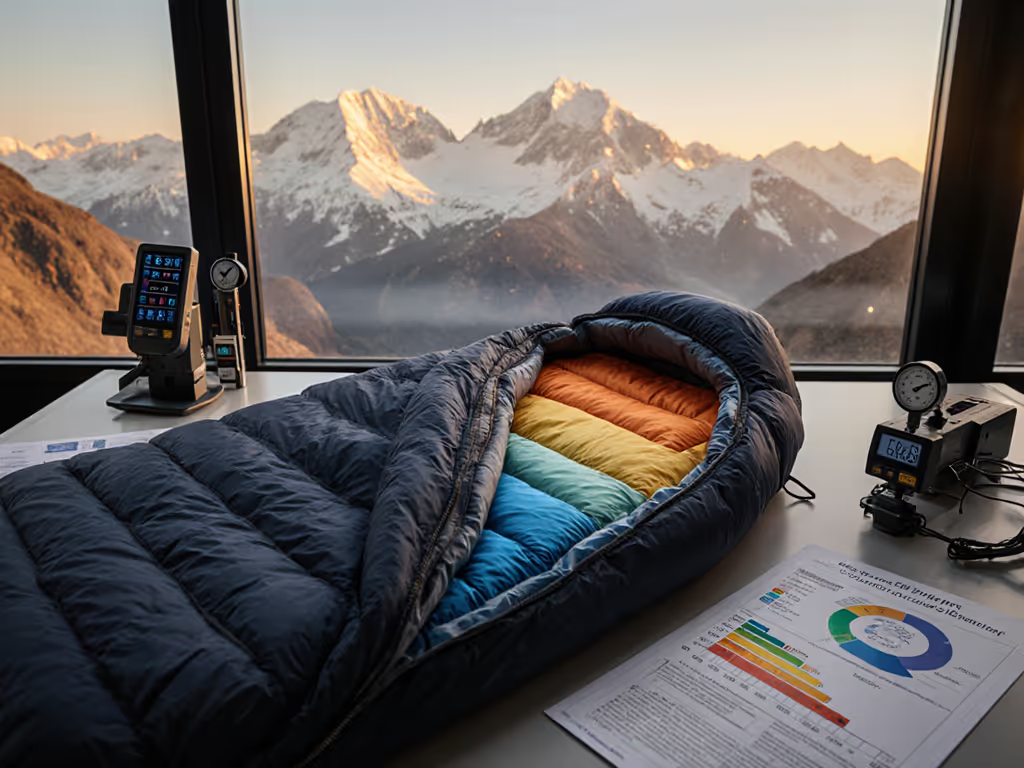
Sleeping bag comfort limit explained and field-adjusted comfort ratings are not one-size-fits-all prescriptions (they are starting points that demand translation). Your true comfort limit depends on your metabolism, sleep position, pad choice, shelter type, and the actual weather you will face. This article breaks down how EN/ISO standards work, where they diverge from real sleep, and how to calculate a personalized comfort margin that keeps you warm, dry, and rested. For a deeper primer on the standard and field translation factors, see our EN/ISO ratings decoded guide.
What EN Ratings Actually Measure
The Standard Behind the Number
When a manufacturer states that a sleeping bag carries a "20°F comfort rating," they are referencing EN 13537, the European standard for thermal performance of sleeping bags. This standard defines four temperature thresholds, each tested using a thermal manikin (a heated, nude, female-shaped dummy) in still, dry lab air within a climatic chamber.
The comfort rating (what you see on most tags) represents the lowest temperature at which a "standard woman" is expected to sleep comfortably without shivering. The lower limit sits about 5-10°F colder and describes the threshold below which a standard man would experience uncontrolled shivering. These are lab numbers, achieved under controlled conditions: no wind, no moisture, no sleeping movement, and no shelter inefficiency.
I once toured a sleeping bag factory and watched a thermal manikin cycle through these protocols (sensors embedded, heaters whirring, chamber perfectly still and dry). Impressive engineering, yet it was striking how artificial the environment was. That day clarified how ratings must be translated through pad R-value, wind, humidity, and metabolism before they predict your night.
The Comfort vs. Lower Limit Distinction
Many campers conflate these two metrics. If you buy a bag rated to 20°F comfort, it does not mean you are safe at 20°F in variable conditions. The comfort rating assumes you are in a decent insulated shelter, wearing base layers, with a reasonable sleeping pad (typically R-value 2-3 assumed by the standard). The lower limit is closer to a survival threshold (you will not die, but you will shiver and sleep poorly).
Standards inform; translation delivers real sleep in real weather. The EN label is a tool, not a guarantee.
Why Lab Ratings Fall Short in the Field
The Lab-to-Field Delta
Several factors routinely widen the gap between EN comfort and your actual comfort in camp:
Pad R-value deficiency: EN assumes an R-value around 2-3, but many ultralight or budget pads hover at R 1-2. Each 0.5-unit drop in R-value can cost you 3-5°F of effective warmth. A 20°F bag on an R 1.5 pad behaves more like a 15°F bag on an R 3 pad.
Shelter thermal loss: Single-wall tents and open bivies shed radiant heat far faster than a sealed lab. Wind infiltration through seams or gaps can drop your microclimate 10-15°F below ambient temperature. EN tests assume you are sheltered from wind.
Moisture and humidity: EN testing uses a dry manikin. In coastal or humid climates, down or synthetic insulation can absorb moisture, losing 30-50% of its loft per 10% moisture gain by weight. Synthetic bags are less catastrophic but still degrade significantly; see our down vs synthetic guide for moisture performance details.
Individual metabolism variance: EN assumes a "standard" metabolism of roughly 100 watts per square meter at rest. Cold-sleepers (low natural thermogenesis) can lose 20-30% of rated warmth. Hot-sleepers gain it back, but overheating causes moisture buildup and condensation, which then chills you as insulation degrades.
Sleep position and fit: A narrow mummy bag that compresses chest or hip insulation (common for side sleepers or broader frames) can reduce effective warmth by 5-15°F compared to a bag that lets you fully loft the down. EN tests use a standardized torso width; your body may not match.
Wind and activity: EN assumes a stationary sleeper. Active campsite setup, restless sleep that shifts you toward the bag wall, or exposed sleeping areas amplify convective heat loss.
The Personalized Comfort Calculation
Step 1: Establish Your Individual Warmth Baseline
Begin by asking: Am I a cold-sleeper, normal, or hot-sleeper? Historical data from your own trips offers the clearest signal. For model picks tailored to your tendencies, see cold vs warm sleeper bags.
If you have consistently felt cold in bags rated to temperatures 5-10°F above the conditions you faced, you are a cold-sleeper. Apply a -5°F to -10°F adjustment to any EN comfort rating before field use. If you have overheated or had condensation issues in bags that felt overly warm, you are a hot-sleeper; add +5°F to +10°F to your margin of caution.
If you lack history, consider: Do you need multiple blankets indoors, even in mild weather? Do you wake with cold feet despite socks? These are indicators of below-average thermogenesis. Conversely, if you regularly shed covers or wake clammy, you are a heat generator.
Step 2: Calculate Your Sleeping System R-Value
Your sleeping pad is often the largest thermal variable. EN assumes R 2-3; measure or research your actual pad R-value. If you use pad-attachment systems, compare pad integration designs to reduce drafts and boost effective R-value.
Individual warmth calculation requires knowing:
- Bag EN comfort rating
- Pad R-value (manufacturer spec or third-party testing)
- Any liner (adds R 0.5-1.5, depending on material)
- Sleep clothing (base layer + socks adds R 0.2-0.5)
As a heuristic: each 1.0 unit of R-value shift (up or down) changes your effective comfort floor by approximately 4-5°F. So a 20°F bag on R 2 pad + base layer (R 2.7 combined insulation) ~ 18-20°F comfort in real conditions. That same bag on an R 4.5 pad + liner + base layer (R ~ 5.5 combined) effectively behaves like a 25-28°F bag in still air.
Ratings predict; systems deliver. No bag exists in isolation.
Step 3: Apply Weather and Shelter Modifiers
Shelter type introduces variability:
- Double-wall tent (good ground-to-roof convection): minimal delta, assume +0 to -2°F loss vs. lab conditions
- Single-wall tent (condensation risk, minimal air circulation): -5 to -8°F loss
- Bivy (severe radiant loss, wind exposure): -10 to -15°F loss
- Hammock with underquilt (if R >= 3): -5 to -10°F loss; without underquilt, extreme cold hazard
Wind exposure multiplies heat loss by 2-4x. A 20°F bag in a windy exposed site can feel like 10-15°F. A calm forest site may only impose -2 to -5°F delta.
Humidity and precipitation demand synthetic or hydrophobic-down bags in rainy zones. If you cannot avoid moisture, apply a -10 to -20°F derate to down-based comfort ratings in wet conditions.
Step 4: Apply Your Personal Adjustment
Combine your cold/hot-sleeper baseline with system R-value and shelter modifiers.
Example: You are a mild cold-sleeper (-7°F adjustment), using a 20°F EN bag, R 3 pad, and base layer (system ~ R 3.5, +2°F effective warmth gain vs. R 2.5 baseline). In a single-wall tent (-6°F loss), windy alpine site (-10°F additional loss):
20°F (EN) + 2°F (pad/layer) - 7°F (cold sleeper) - 6°F (shelter) - 10°F (wind) = -1°F effective comfort.
Your personalized comfort limit is approximately -1°F, with safety margin. For a trip to 0°F terrain, you would want a warmer bag or upgraded pad.
Sleeping Bag Liners and Layers: Quantifying the Gain
Sleeping bag liners for warmth are often misunderstood. A silk liner adds R 0.5-0.7; a fleece liner adds R 1.0-1.5. A thermal liner (insulated polyester) can add R 1.5-2.0. These are real, measurable gains, particularly for ultralight setups where upgrading the bag itself is heavy or expensive. Get exact warmth boosts and material pros/cons in our sleeping bag liner guide.
For a 30°F bag you want to use at 15°F: a thermal liner (+1.5°F equivalent gain) plus an R 4 pad (+5°F equivalent system boost) could net you a real 20°F comfort zone without a new bag.
However, liners add bulk, complexity, and condensation risk if not managed. They are most effective in dry, calm conditions and for cold-sleepers who value system flexibility.
Building Your Field-Adjusted Comfort Rating
Field-adjusted comfort rating is the temperature at which you personally expect to sleep well in your intended shelter and conditions, given your body, your gear, and the real weather.
Create a simple table for each trip scenario:
| Factor | Value | Adjustment |
|---|---|---|
| EN Comfort Rating | 20°F | Baseline |
| Personal Cold-Sleeper Offset | -7°F | -7°F |
| Pad + Liner System R-Value | 3.5 | +2°F |
| Shelter Type (Single-Wall) | - | -6°F |
| Expected Wind Exposure | Moderate | -8°F |
| Your Personalized Comfort | - | +1°F |
Store these tables as trip notes or spreadsheet templates. Over time, patterns emerge: you learn your wind tolerance, your pad preference, and the margin you need for a good night. Uncertainty narrows.
Practical Takeaways
- EN ratings assume ideal conditions: still air, dry insulation, decent shelter, and average metabolism. Your conditions are not ideal.
- Always quantify your pad R-value and factor it into any comfort estimate. A pad upgrade often yields more return-on-warmth than a new bag.
- Cold-sleepers and hot-sleepers need different strategies. Cold-sleepers benefit from higher R-value systems and warmer bags; hot-sleepers need breathable bags and selective layering to avoid moisture.
- Shelter and wind dominate real-world comfort. A good bivy or windy site can negate 10-20°F of rated warmth.
- Test your system in shoulder seasons before alpine or winter trips. Build confidence in your personal adjustments before you rely on them in extreme conditions.
Your true comfort limit is not a number on a tag. It is a synthesis of standards, personal physiology, and the reality of your camp. Measure, adjust, and sleep well.
Related Articles