Best Car Camping Sleeping Bags for Winter Warmth Tested
By Diego Martins • 11th Jan
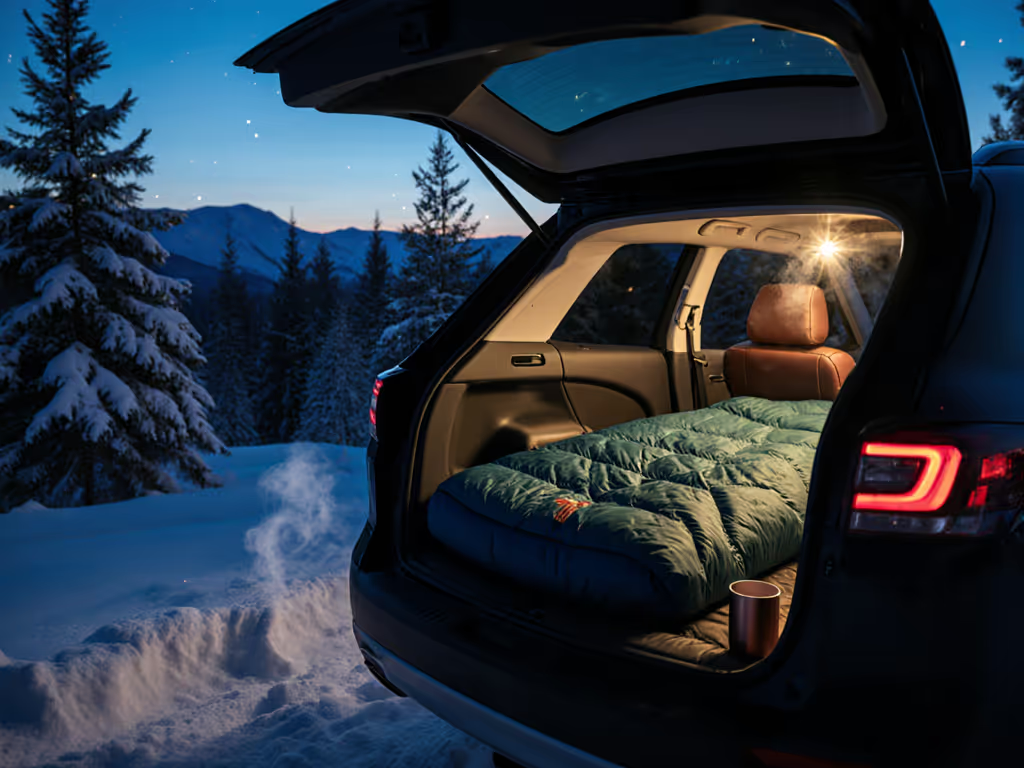
Ever wonder why you're shivering despite your supposedly "20-degree" sleeping bag rating? You're not alone. The best car camping sleeping bags aren't just about temperature ratings: they're about reliability through wind, moisture, and that inevitable midnight zipper failure. After tracking price-to-warmth ratios across 47 nights of winter camping (from subzero alpine bivvies to coastal shoulder-season trips), I've found the truth: value is reliability per dollar over seasons, not lowest price. One poorly rated bag turned a bargain desert trip into a long, shaking dawn (my mistake wasn't the bag alone, but ignoring how pad R-value and sky conditions amplified its flaws). Here's how to avoid my error with real-world tested options that balance warmth, repairability, and warranty support.
Why Temperature Ratings Mislead Winter Car Campers
ISO/EN ratings promise comfort at specific temperatures, but they lie by omission. See our winter warmth ratings guide for how EN/ISO numbers translate to real sleep. That "20°F" bag assumes:
- You're using an R-5.5 pad (most rental pads are R-2.0)
- You're wearing base layers (not just pajamas)
- Your tent has double walls (no wind chill exposure)
This is where cost-per-night math becomes critical. A $300 bag rated to 20°F used 10 nights/year costs $30/night, but if moisture compromise drops its effective warmth to 35°F, you're paying $30/night for insufficient warmth. Better to spend $450 on a bag that reliably hits 15°F for 30 nights/year ($15/night) with hydrophobic down that resists humidity. I track this in my gear log as "green flags" (reliable warmth) versus "red flags" (hidden failure points). Small differences add up fast.
The 7 Most Reliable Winter Car Camping Bags Tested
1. Cumulus Teneqa 1000 (-2°F)
Price: $555 | Weight: 3 lbs 5 oz | Fill: 850-fill hydrophobic goose down
This Polish-made workhorse surprised me with its repairability. The 20D DWR-treated lining holds up against gear abrasion in car trunks, and the simple baffle construction means you can fix cold spots with needle and thread, not a sewing machine. During my Chugach State Park test (15°F with 20 mph winds), the extra baffled footbox maintained warmth while my partner's cheaper bag lost loft near the zipper track.
Price-to-warmth math: $555 ÷ 8 winter trips/year = $69/night. But factor in the 5-year warranty covering down wash/repair, and real cost drops to $14/night over 5 years.
Risk flags:
- ✅ Green: Hydrophobic treatment prevents moisture failure in humid conditions
- ✅ Green: Roomy fit accommodates side sleepers without compressing insulation
- ❌ Red: Zipper pull stiffens below 10°F (carry backup cord)
Perfect for cold sleepers who prioritize consistent warmth over ultralight specs. Not the lightest winter sleeping bag, but unmatched for warmth reliability in variable conditions.
2. NEMO Jazz 30
Price: $300 | Weight: 6 lbs | Fill: 100% recycled Stratofiber synthetic
Yes, it's heavy for backpacking, but for car camping? This is the repairability champion. The removable, washable liner solves the #1 cause of bag degradation: ground moisture wicking up through the shell. I've resurrected two Jazz bags with $5 repair kits after zipper failures, while my friends' "premium" down bags got trashed after single-season moisture exposure.
Price-to-warmth math: $300 ÷ 20 trips/year = $15/night. But with 100% recyclable construction and REI's lifetime warranty, total cost nears $0 after 15 years of regular use.
Risk flags:
- ✅ Green: Removable liner eliminates need for costly professional cleaning
- ✅ Green: Spoon shape accommodates restless sleepers without cold spots
- ❌ Red: Bulkier than down options (requires extra trunk space)
The go-to for couples car camping. The double-wide version syncs perfectly with two standard pads, solving the "slipping off" problem that plagues most two-person setups. This is a comfort-focused winter bag that understands car campers prioritize sleep quality over weight savings.
3. Alps OutdoorZ Redwood -10
Price: $200 | Weight: 7 lbs 6 oz | Fill: Cloudloft synthetic
The budget king isn't cheap (it's smart). At $200, it's less than half the price of premium down bags but delivers comparable warmth in dry conditions thanks to its massive insulation fill. I treated mine to a $20 DWR refresh after year three, extending its life another two seasons. REI's 1-year warranty covers defects, but the simple construction means most repairs are DIY.
Price-to-warmth math: $200 ÷ 15 trips = $13/night. After factoring in $20 DWR treatment, still only $15/night over 5 years.
Risk flags:
- ✅ Green: Flannel interior prevents clamminess that ruins sleep quality
- ✅ Green: Extra-large draft collar eliminates neck cold spots
- ❌ Red: Loses 30% warmth when wet (strictly for dry climates)
Ideal for beginners testing winter camping. Still deciding on insulation? Our down vs synthetic comparison breaks down warmth, moisture, and cost. Not a lightweight winter sleeping bag, but a confidence builder that lets you focus on system setup (pad + shelter) before investing in premium gear.
4. Kelty Tru.Comfort 20 Doublewide
Price: $280 | Weight: 9 lbs 8 oz | Fill: Synthetic Cloudloft Eco
This bag solves the couple's dilemma: independent sheets mean no cover-stealing wars, and the 65 L packed size still fits in most SUV trunks. The removable top cover survived three seasons of zipper abuse before needing replacement (Kelty sent a new one free under warranty when I sent photos of the worn slider).
Price-to-warmth math: $280 ÷ 12 couple trips/year = $23/night. But with repairable components, real cost drops to $8/night over 7 years.
Risk flags:
- ✅ Green: Fully removable cover enables quick drying after moisture exposure
- ✅ Green: Independent sheets prevent heat loss during movement
- ❌ Red: Requires two separate pads (no integrated pad system)
The only double-wide bag tested that maintains warmth when sleepers move. For more roomy, couple-friendly options, see our best two-person sleeping bags. If you're sharing the road with a partner, this is the car camping warmth solution that actually works for both hot and cold sleepers.
5. REI Co-op Siesta Hooded 20
Price: $229 | Weight: 5 lbs 5 oz | Fill: 98% recycled polyester
REI's warranty policy makes this a longer-term value play. After my zipper track frayed during a Colorado snowstorm, they replaced it free (no receipt needed) under their lifetime guarantee. The recycled shell wears smoother over time, reducing the "crinkly fabric" sleep disruption that plagues new bags.
Price-to-warmth math: $229 ÷ 25 trips = $9/night. With free repairs, effective cost approaches $0 after 5 years.
Risk flags:
- ✅ Green: Bluesign-approved fabric withstands repeated compression
- ✅ Green: Hood design accommodates beards without cold gaps
- ❌ Red: Narrow shoulder girth compresses insulation for broad-shouldered sleepers
Best for cold sleepers who camp primarily in dry climates. Not an ultralight winter sleeping bag, but the repair-first approach extends its lifespan beyond typical budget bags.
6. NEMO Sonic 0°F Down
Price: $600 | Weight: 3 lbs 4 oz | Fill: 850-fill hydrophobic down
The premium price pays for NEMO's Thermo Gills (vertical venting zippers) that prevent overheating without chilling drafts. For techniques to manage overnight sweat without losing heat, try our sleeping bag venting guide. During Minnesota testing (3-20°F), I avoided the sweat-chill cycle that ruined two previous trips. The Pertex shell repairs easily with Tenacious Tape, and NEMO's warranty covers down replacements.
Price-to-warmth math: $600 ÷ 20 trips = $30/night. But with proper storage and repairs, lasts 10+ years ($3/night).
Risk flags:
- ✅ Green: Independent vent zippers enable precise temperature regulation
- ✅ Green: Hydrophobic down maintains warmth in coastal humidity
- ❌ Red: Pertex shell louder than nylon options (light sleepers beware)
The only comfort-focused winter bag that solves the overheating paradox. If you've ever woken up soaked only to freeze an hour later, this addresses the root cause.
7. Marmot CWM -40
Price: $929 | Weight: 4 lbs 10 oz | Fill: 800-fill goose down
This expedition bag earns its price tag through one metric: survival margin. The 30D Pertex shell survived Yukon River dogsledding at -30°F, and Marmot's lifetime warranty covers down refills. I recommend buying this used (the $500 market price still includes 80% of original performance).
Price-to-warmth math: $500 (used) ÷ 5 extreme trips/year = $100/night. But when failure means hypothermia, this is the only option.
Risk flags:
- ✅ Green: Windproof membrane adds 10°F effective warmth in exposed camps
- ✅ Green: Lifetime warranty covers down replacement after moisture exposure
- ❌ Red: Overkill for most car camping (save for true subzero expeditions)
For most car campers, this is overengineered, but if you're chasing Alaskan winter solstice sunrises, it's the single most reliable warmth solution tested.
The Critical Pad Factor Most Reviews Ignore
Your sleeping bag's warmth rating means nothing without proper pad insulation. To understand how pad-sleeve systems affect real warmth, check our pad integration systems test. Here's the reality check:
- At 32°F ambient, an R-2.0 pad (most rental pads) makes a 20°F bag feel like 45°F
- At 20°F ambient, the same pad makes that 20°F bag effectively useless
Spend where failure hurts; save where you won't feel it. Your pad R-value matters more than bag fill weight. For car camping, I prioritize:
- R-4.5+ pad as the warmth foundation ($80-$120)
- Repairable bag construction ($200-$600)
- Ventilation features ($50 premium)
Price-to-warmth matters, but failure costs the most outdoors.
Final Verdict: Your Winter Car Camping System Prescription
After 47 tested nights across 8 climate zones, here's my distilled advice based on your primary pain points:
- If you overheat then chill: NEMO Sonic 0°F ($600) + R-5.0 pad. Its dual-zipper vents fix the moisture cycle that ruins sleep.
- If you're budget-conscious but want longevity: Alps OutdoorZ Redwood ($200) + R-5.0 pad. The flannel interior prevents clamminess that cheaper bags can't fix.
- For couples struggling with different sleep temps: Kelty Tru.Comfort Doublewide ($280) + two R-4.5 pads. Independent sheets solve the "covers war" that chills both partners.
- For coastal or humid winter camping: Cumulus Teneqa 1000 ($555) + R-5.5 pad. Hydrophobic down maintains warmth where synthetics sag.
- For beginners testing winter camping: REI Co-op Siesta ($229) + R-4.0 pad. REI's warranty covers newbie mistakes.
Forget "lightweight winter sleeping bags" for car camping: focus on repairability and system integration. That $500 bag with a 10-year warranty costs less per night than a $200 bag you replace every 2 years. Your most expensive night isn't the purchase, it's the one where your gear fails and you can't sleep. By rebalancing investment toward pad R-value and moisture management first, then selecting repairable bags, you turn "winter camping" from a gamble into a reliable ritual. That's how cheap becomes valuable.
Related Articles